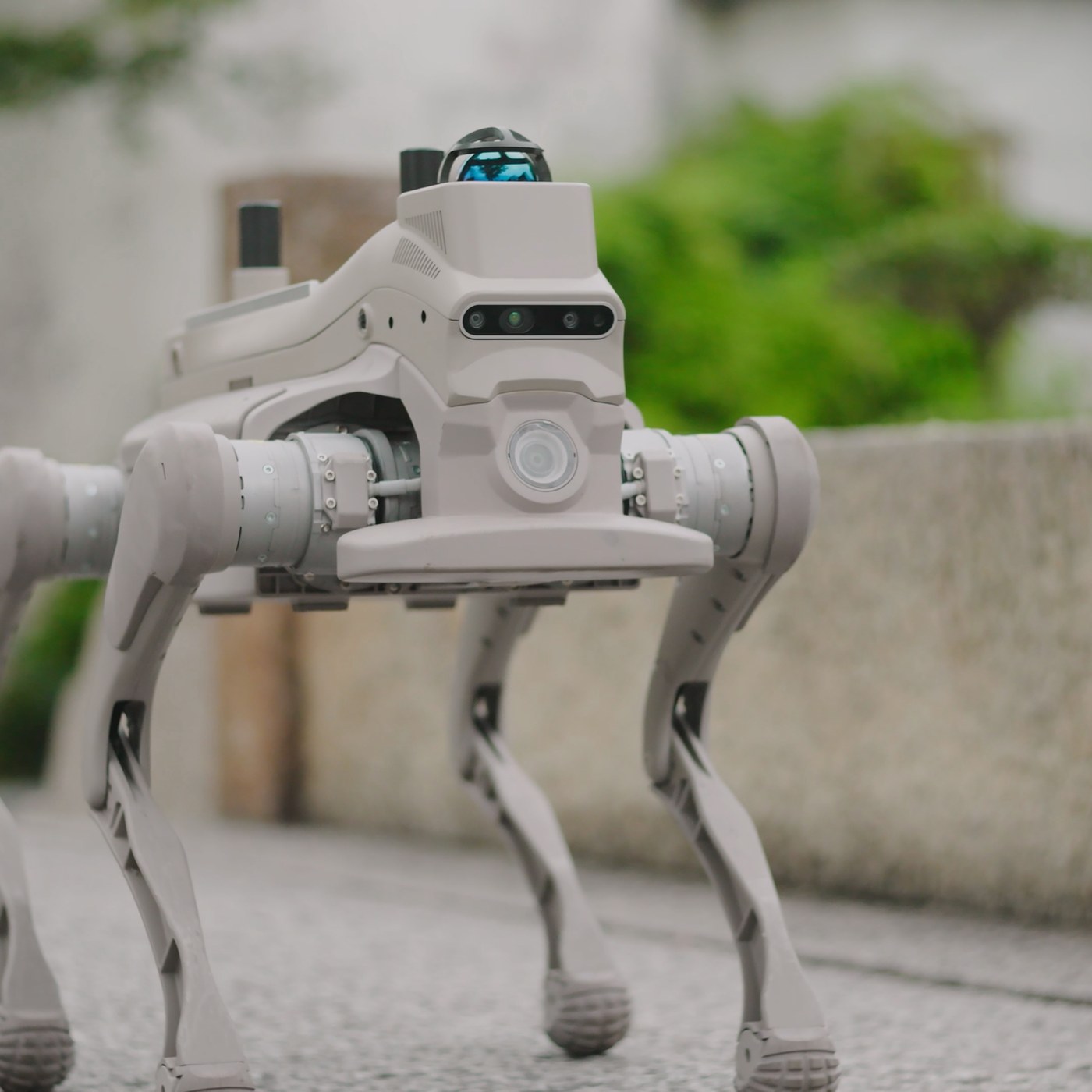
The gap this robot fills
A toy kitStudents can take it apart. The joints are hobby servos, so the gait and the load are not what a factory uses.A sealed research robotThe motion is real. A class usually watches, because the machine is not built to be rebuilt thirty times.MakerL1 is the body students assemble. Maker is that education line with Orin NX, a Mid-360 lidar, a RealSense camera, and RoamerX Lite.
Who it is for
University labsA robotics or AI lab that needs more than one sealed machine for a semester of projects and competitions.Vocational collegesA workshop where the calibration steps match the factory, so the skill transfers to a job.STEM distributorsA supplier that needs a category between a toy kit and a research robot, with a course pack attached.Training centersA maker space or skills program that wants students to build a robot they can also program.
One robot across four years
Year oneTake the robot apart and put it back. Learn what is inside a joint.Year twoPower, wiring, and control, on Ethernet, USB, SBUS, and UART.Year threeRun the production calibration: serial number, zero position, joint test, and bring-up. Then navigation.Year fourTrain in simulation, then run the policy on the robot. Maker does that with RoamerX Lite on Orin NX.
What arrives with the robot
In the caseA parts list, an assembly guide, a calibration-software license, and a teaching pack.For teachersA one-week instructor course for up to thirty teachers, so the first class does not depend on one specialist. The education manual describes two certificates: one for instructors and one for students.When the course needs navigationKingkir Maker is the L1 EDU set: Orin NX 16 GB, a Livox Mid-360, RealSense, and RoamerX Lite. RoamerX Pro is optional.Ask for theseA handheld remote, a screened remote, a carrying case, or a spare-joint pack. A separate assembly-and-repair course can be requested.
The first lesson
Ninety minutesThe first class is an assembly challenge. Students build the robot in that hour. The lecture comes after it runs.Power on after reassemblyThe joints are designed to run after the robot is taken apart and put back, without a bench recalibration.A body that can be droppedAn inner frame and a soft outer shell. The design target is more than thirty component-level rebuilds.
What a class can measure on L1
These lines are laboratory figures from the education-program specification. The L1 and Maker catalog pages keep the 2026 brochure tables. That brochure prints L1 range as up to 6 km. The education manual's no-load laboratory range is 9 km.
MotionsStand, lie down, damp, pitch the body, change height, and turn in place. Also jump forward, jump up, and climb onto a platform.Joint travelBody −28° to 28°. Thigh −170° to 66°. Shin 34.5° to 156°. Twelve degrees of freedom, twelve aluminum joint modules, 48 N·m peak.CameraAn FPV camera, about 122° on the diagonal, 111° horizontal, and 70° vertical, with live video. An IMU is standard. Target tracking is listed as supported.Power and updatesCharge about one hour at 25 °C. The pack is 43.2 V, nominal 5 Ah, rated 4.6 Ah, and quick-swap. Software updates over the air. The charger and dock are standard.BodyStanding about 630 × 360 × 415 mm. Lying about 670 × 425 × 145 mm. About 15 kg with the battery. Aluminum alloy and high-strength engineering plastic: an inner frame and a soft outer shell.Motion figuresUp to 3.7 m/s. Walking payload 8 kg, limit 10 kg. Continuous stairs 16 cm. Slope 30°, listed limit 40°. Jump height 35 cm. Listed maximum power 3500 W. Operating range on this sheet is 0 °C to 40 °C.Compute and portsAn 8-core CPU. Ethernet, USB, power, SBUS, and UART. The open SDK and the MATRiX simulator. The manual's no-load laboratory range is 9 km; the brochure still prints up to 6 km.
The education product manual lists an FCC grant for the L1 series, ID 2BVPE-L1L1W. The same appendix lists test reports RBJ260416001-00B for Part 15.247, RBJ260416001-00C and RBJ260416001-00D for Part 15.407, RBJ260416001-00A for Part 15A, and RBJ260416002-00A for Part 15B, plus SDoC files RBJ260416001 and RBJ260416002. Those identifiers are the manual's identifiers. CE, UKCA, and RCM are in that manual as a plan for later markets, not as certificates this page can show. The same manual treats the battery as about 216 Wh and says an air shipment follows the dangerous-goods process. Ask for the UN38.3 report with the order.
How a school starts
One or two robotsProve the class: assembly, calibration, and one logged assignment.A classroom setEnough machines that students build, instead of waiting for a turn.A yearly frameA department or a group of campuses adds robots, spares, and the next instructor course.
Warranty
The main board and the joint motors are covered for 12 months from activation. The charger, battery, and FPV camera are covered for 6 months, and the battery also for 200 cycles. A handheld remote is 12 months. A screened remote is 6. If the robot is never activated, coverage starts 90 days after delivery.
How a class is run
A course still moves through three rooms. Simulation, where a policy can fail for free. A speed-limited lab, with an e-stop and a geofence. A logged route, which is the assignment you can mark. L2 and the other field platforms are for operators, not for a first lab session. The numbers on the L1 and Maker pages are laboratory figures from the 2026 brochure. A classroom robot will differ with the floor, the load, and how it was built that day.
Tell us the department, the term, and how many students will touch the robot. The price is confirmed on the quote.